Slow-Blues.com — Global Blues Encyclopedia
Back to artists
B.B. King
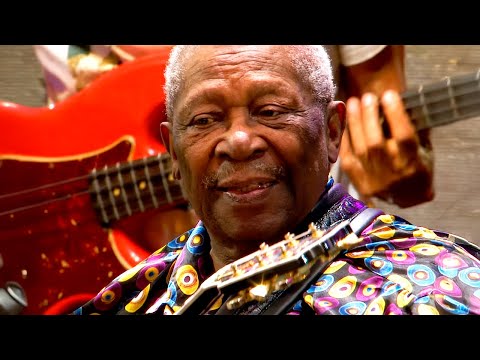
1984 performance photograph — photographer unrecorded/unknown (Wikimedia Commons, public domain)
Classic

B.B. King

This artist is no longer with us.
Born: September 16, 1925, near Berclair, Itta Bena, Mississippi · Died: May 14, 2015, Las Vegas, Nevada (vascular dementia, complications from type 2 diabetes and high blood pressure)• United States
Electric BluesSoul Blues
Instruments
Gibson ES-355 "Lucille", Voice
Labels
RPM, Kent, ABC-Paramount, MCA
from
Mississippi Delta → Memphis
Born
September 16, 1925, near Berclair, Itta Bena, Mississippi
B.B. King never strummed a chord behind his own solos — he sang a line, then let his guitar Lucille sing the answer back. That call-and-response between voice and a single sustained, vibrato-heavy note became the most widely copied vocabulary in electric blues guitar, and he built a touring career on it that ran, by most counts, well past 15,000 shows. He was born Riley B. King on September 16, 1925, on a cotton plantation near Berclair, close to Itta Bena, Mississippi, to sharecroppers Albert and Nora Ella King. His parents separated when he was four, and his maternal grandmother, Elnora Farr, raised him in Kilmichael and then Lexington, Mississippi. As a teenager he moved to Indianola to work at a cotton gin; a local minister showed him three chords on a Sears Roebuck Silvertone guitar, and his employer, Flake Cartledge, bought him his first guitar for fifteen dollars (Kilde: Wikipedia). He relocated to Memphis in 1946, staying with his cousin, bluesman Bukka White. By 1948 he was performing on Sonny Boy Williamson's radio program on KWEM in West Memphis, which led to a ten-minute slot on Memphis station WDIA that grew into the "Sepia Swing Club." It was at WDIA that he picked up the nickname "Beale Street Blues Boy," which got shortened, permanently, to "B.B." (Kilde: Wikipedia). The story behind his guitar's name is one of the most retold in blues history: during a performance in Twist, Arkansas, a brawl between two men knocked over a kerosene stove and set the club on fire. King ran back inside to retrieve his guitar after everyone had escaped, nearly losing his life doing it, and later learned the fight had been over a woman named Lucille. He named the guitar after her as a permanent reminder never to do something that reckless over a woman — or a fire — again (Kilde: Wikipedia). He signed with RPM Records, a subsidiary of Modern Records, in 1949, with Sam Phillips producing some of his earliest sessions before Phillips went on to found Sun Records. His debut single, "Miss Martha King," came out that year on Bullet Records. His real breakthrough arrived in February 1952 with "3 O'Clock Blues," his first number-one hit on the R&B chart (Kilde: Wikipedia). Through the 1950s he recorded for RPM, Crown and Kent Records, moved to ABC-Paramount in 1962, and stayed with that label's successors — ABC, BluesWay, MCA and eventually Geffen — for the rest of his recording career (Kilde: Wikipedia). His live album "Live at the Regal," recorded at Chicago's Regal Theater in November 1964, is widely considered one of the greatest live blues (or live anything) albums ever made — King himself called it "considered by some the best recording I've ever had." His biggest crossover hit, "The Thrill Is Gone," came out in December 1969 from the album "Completely Well," won him a Grammy, and carried him onto mainstream American radio for the first time in his career (Kilde: Wikipedia). His touring pace bordered on the superhuman: he played an average of over 200 shows a year well into his seventies, and in 1956 alone completed 342 concerts — sometimes performing multiple shows a night in different towns. He collaborated with Eric Clapton on the 2000 album "Riding with the King," which won a Grammy for Best Traditional Blues Album, and appeared on U2's "When Love Comes to Town" from "Rattle and Hum" in 1988 (Kilde: Wikipedia). Across his career he won 15 Grammy Awards, including a Lifetime Achievement Award in 1987, and was inducted into the Blues Hall of Fame (1980) and the Rock and Roll Hall of Fame (1987). President George W. Bush awarded him the Presidential Medal of Freedom on December 15, 2006, on top of the National Medal of Arts (1990), Kennedy Center Honors (1995) and the Polar Music Prize (2004) (Kilde: Wikipedia). He died in his sleep in Las Vegas, Nevada, on May 14, 2015, at 89, of vascular dementia related to complications from type 2 diabetes and high blood pressure. His body was flown to Memphis, where a hearse traveled down Beale Street accompanied by a brass band playing "When the Saints Go Marching In" while thousands lined the streets, before a procession down Route 61 to Indianola, Mississippi, for his funeral and burial at the B.B. King Museum and Delta Interpretive Center (Kilde: Wikipedia).

Musical Influence

AllMusic has called him "the single most important electric guitarist of the last half of the 20th century," and the list of guitarists who cite him as a direct influence covers nearly the entire history of electric blues and rock guitar since the 1950s. His 2000 collaboration album with Eric Clapton, "Riding with the King," introduced him to a new generation, and his guest appearance on U2's "When Love Comes to Town" carried his sound directly into mainstream rock. Songs including "The Thrill Is Gone," "Every Day I Have the Blues" and "Sweet Little Angel" remain blues and rock standards performed by musicians worldwide (Kilde: Wikipedia).

Influences

T-Bone WalkerLonnie JohnsonDjango ReinhardtCharlie Christian

Family and personal life

Parents

Sharecroppers; separated when Riley was four.

Grandmother

Raised him in Kilmichael and Lexington, Mississippi after his parents separated.

Cousin

Bluesman; King stayed with him after moving to Memphis in 1946.

Formative experiences

  • •1946: Moved to Memphis, staying with cousin Bukka White. (Kilde: Wikipedia)
  • •1948: Got his own radio slot on WDIA, earning the nickname "Beale Street Blues Boy" — shortened to "B.B." (Kilde: Wikipedia)
  • •1949: Ran back into a burning club in Twist, Arkansas to save his guitar, later naming it "Lucille." (Kilde: Wikipedia)
  • •February 1952: "3 O'Clock Blues" became his first #1 R&B hit. (Kilde: Wikipedia)
  • •November 1964: Recorded "Live at the Regal" in Chicago. (Kilde: Wikipedia)
  • •December 2006: Awarded the Presidential Medal of Freedom. (Kilde: Wikipedia)

Instruments & Equipment

Guitar

Gibson ES-355 "Lucille"

Named after a woman two men fought over, sparking a nightclub fire King nearly died retrieving his guitar from in 1949.

Stories & Anecdotes

"Named his guitar "Lucille" after nearly dying retrieving it from a burning club in Twist, Arkansas — the fire started when two men fought over a woman by that name. (Kilde: Wikipedia)"
"Played an average of over 200 shows a year well into his seventies, and completed 342 concerts in 1956 alone. (Kilde: Wikipedia)"
"His funeral procession traveled down Beale Street in Memphis accompanied by a brass band playing "When the Saints Go Marching In," watched by thousands. (Kilde: Wikipedia)"

Collaborators

Cousin and bluesman who hosted King in Memphis in 1946.

Collaborated on the 2000 Grammy-winning album "Riding with the King."

Guest appearance on "When Love Comes to Town," from "Rattle and Hum" (1988).

Produced some of his earliest RPM sessions before founding Sun Records.

Watch & Listen

Featured

B.B. King - The Thrill Is Gone ( 1969 ) HD

His biggest crossover hit, from "Completely Well" (1969) — won a Grammy and brought him to mainstream radio.

Nicolas Reboux

Watch & Listen

Henter videoer fra YouTube…

Discography

YearTitleProducerStudioLabelChartSalesMusiciansYouTubeNotes
1949Bullet / RPM Records debutSam Phillips—Bullet / RPM——Phineas Newborn (Piano), Calvin Newborn (Guitar), Tuff Green (Bass), Ben Branch (Tenor saxophone), Thomas Branch (Trumpet)Debut single "Miss Martha King" on Bullet; signed to RPM (Modern Records subsidiary), some early sessions produced by Sam Phillips.
1952"3 O'Clock Blues"RPM Records—RPM———His first #1 R&B hit, released February 1952.
1956"Sweet Little Angel"RPM/Kent—RPM / Kent———Later re-recorded live for "Live at the Regal."
1958Crown Records eraCrown Records—Crown———Album releases through the late 1950s.
1962ABC-Paramount Records era beginsABC-Paramount—ABC-Paramount———Moved labels; stayed with ABC's successors for the rest of his career.
1964Live at the RegalABC-Paramount—ABC-Paramount———Recorded November 1964 at Chicago's Regal Theater — widely considered one of the greatest live blues albums ever made.
1969Completely Well ("The Thrill Is Gone")Bill Szymczyk—ABC/BluesWay———Released December 1969; his biggest crossover hit, won a Grammy.
2000Riding with the KingSimon Climie—Reprise / Duck——Eric Clapton (Guitar/Vocals)Collaboration album with Eric Clapton; won the Grammy for Best Traditional Blues Album.
2008One Kind FavorT Bone Burnett—Geffen———Final studio album; won a Grammy.

Famous songs

01The Thrill Is Gone
02Every Day I Have the Blues
03Sweet Little Angel
043 O'Clock Blues

External links

Sources

Keep SlowBlues independent. Official merch — wear the blues.

Shop merch