Slow-Blues.com — Global Blues Encyclopedia
Back to artists
Elmore James
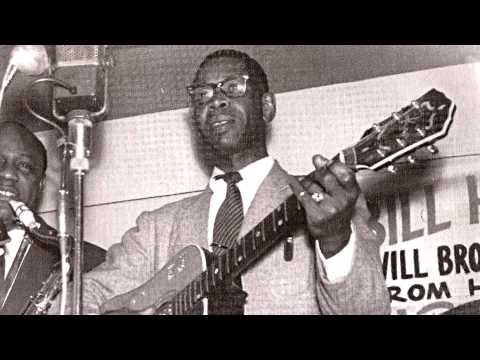
Performance/publicity photograph — photographer unrecorded/unknown (Wikimedia Commons, public domain)
Chicago

Elmore James

This artist is no longer with us.
Born: January 27, 1918, Richland, Holmes County, Mississippi · Died: May 24, 1963, Chicago, Illinois (heart attack)• United States
Chicago BluesElectric Slide Blues
George Harrison name-checked him directly on "For You Blue" — "Elmore James got nothin' on this, baby" — which tells you roughly how large Elmore James's slide guitar riff loomed over an entire generation of British and American guitarists who came after him. Nearly all of it rests on one song he didn't even write. He was born Elmore Brooks on January 27, 1918, in Richland, Holmes County, Mississippi, the son of a fifteen-year-old field hand, Leola Brooks; his likely father, Joe Willie "Frost" James, gave the boy the surname he'd perform under for the rest of his life (Kilde: Wikipedia). He started making music at twelve on a homemade one-string instrument nailed to the wall of a shack, and performed as a teenager under the names "Cleanhead" and "Joe Willie James." He absorbed direct influence from Robert Johnson, Kokomo Arnold and Tampa Red, and in the late 1930s worked alongside Sonny Boy Williamson II (Kilde: Wikipedia). He served in the U.S. Navy during World War II, was promoted to coxswain, and took part in the invasion of Guam. After his discharge he settled in Canton, Mississippi, and in January 1951 began recording as a sideman for Trumpet Records. That August, he made his debut as a session leader in his own right, cutting a Robert Johnson composition — "Dust My Broom" — that became, almost by accident, a surprise R&B hit in 1952 and the song that would define his entire career (Kilde: Wikipedia). Talent scout Ike Turner brought him to the Bihari brothers' stable of labels — Flair, Meteor and Modern — through the mid-1950s, where he cut "I Believe" among other sides, before further sessions for Chess and for Mel London's Chief Records. From 1959 onward he recorded for Bobby Robinson's Fire Records, the label responsible for many of his most enduring performances, including "The Sky Is Crying," recorded in Chicago on November 3 or 4, 1959 — reportedly written on the spot, inspired by rain falling outside the studio during the session — and released in March 1960 (Kilde: Wikipedia). His backing band, built around pianist "Little" Johnny Jones and drummer Odie Payne, both formerly of Tampa Red's outfit, eventually took its own name directly from his signature song: the Broomdusters. He became known — and eventually nicknamed "King of the Slide Guitar" — for playing his amplified slide guitar at volumes that were considered genuinely loud even by the standards of electric Chicago blues, an approach that fed directly into the sound rock guitarists would later chase. His catalogue through the late 1950s and early 1960s includes "It Hurts Me Too" (a Tampa Red song he made his own), "Shake Your Moneymaker" and "Look on Yonder Wall," both from 1961, and "One Way Out," released in 1965 after his death (Kilde: Wikipedia). He died of a heart attack on May 24, 1963, at his cousin Homesick James's home in Chicago, at 45. He was buried at Newport Baptist Church Cemetery in Ebenezer, Mississippi; his current granite headstone, unveiled in 1992 and featuring a bronze relief of him playing guitar under the words "King of the Slide Guitar," was funded by Capricorn Records founder Phil Walden (Kilde: Wikipedia).

Musical Influence

Jimi Hendrix, Duane Allman, Jerry Garcia, Derek Trucks, Brian Jones and Frank Zappa have all been directly linked to his slide guitar style, and Fleetwood Mac's Jeremy Spencer built much of his early career on note-for-note recreations of James's playing. George Harrison referenced him by name in the Beatles' "For You Blue." Blues guitarists Homesick James, Hound Dog Taylor and J.B. Hutto carried his amplified slide sound forward directly into the next generation of Chicago blues (Kilde: Wikipedia).

Influences

Robert JohnsonKokomo ArnoldTampa Red

Family and personal life

Mother

A field hand, aged fifteen at the time of Elmore's birth.

Father (likely)

Gave young Elmore the surname James.

Cousin

Fellow bluesman; Elmore died at his Chicago home in 1963.

Formative experiences

  • •Age 12: Began playing on a homemade one-string instrument. (Kilde: Wikipedia)
  • •WWII: Served in the U.S. Navy, promoted to coxswain, took part in the invasion of Guam. (Kilde: Wikipedia)
  • •August 1951: Recorded "Dust My Broom" as his debut session-leader single. (Kilde: Wikipedia)
  • •November 1959: Wrote and recorded "The Sky Is Crying," reportedly inspired by rain outside the studio. (Kilde: Wikipedia)
  • •May 24, 1963: Died of a heart attack in Chicago at 45. (Kilde: Wikipedia)

Instruments & Equipment

Guitar

Amplified slide guitar

Known for playing at unusually loud volumes even by electric Chicago blues standards, earning him the nickname "King of the Slide Guitar."

Stories & Anecdotes

""The Sky Is Crying" was reportedly written on the spot during the recording session, inspired by rain falling outside the studio. (Kilde: Wikipedia)"
"His backing band took its name, the Broomdusters, directly from his signature hit "Dust My Broom." (Kilde: Wikipedia)"
"George Harrison referenced him by name in the Beatles song "For You Blue." (Kilde: Wikipedia)"

Collaborators

Pianist in his backing band, the Broomdusters; formerly with Tampa Red.

Drummer in the Broomdusters; formerly with Tampa Red.

Talent scout who brought him to the Bihari brothers' labels in the mid-1950s.

Watch & Listen

Featured

Elmore James - Dust My Broom (1951)

His breakthrough single, a Robert Johnson composition that became a surprise R&B hit in 1952 and defined his entire career.

Overjazz

Watch & Listen

Henter videoer fra YouTube…

Discography

YearTitleProducerStudioLabelChartSalesMusiciansYouTubeNotes
1951Trumpet Records era, Jackson, MississippiLillian McMurry—Trumpet———Debut as sideman, then as session leader with "Dust My Broom" (August 1951), a Robert Johnson composition that became a surprise hit in 1952.
1953Flair / Meteor / Modern Records era, via Ike TurnerBihari brothers—Flair / Meteor / Modern——"Little" Johnny Jones (Piano), Odie Payne (Drums), Ike Turner (Guitar, piano)Includes "I Believe." Ike Turner played guitar and piano on some of these Bihari-brothers sessions.
1955Chess Records sessionsChess—Chess——"Little" Johnny Jones (Piano), Odie Payne (Drums)Additional mid-1950s sides.
1957Chief Records era, ChicagoMel London—Chief——"Little" Johnny Jones (Piano), Odie Payne (Drums)Includes his version of "It Hurts Me Too." The Broomdusters, both inherited from Tampa Red's band, remained his core backing unit into the Chief Records era.
1959Fire Records era, ChicagoBobby Robinson—Fire——"Little" Johnny Jones (Piano), Odie Payne (Drums)"The Sky Is Crying" (recorded Nov 3–4 1959, released March 1960), "Shake Your Moneymaker" and "Look on Yonder Wall" (both 1961) — most enduring performances of his career.
1965"One Way Out" (posthumous release)Fire / Enjoy—Fire / Enjoy———Released after his 1963 death.

Famous songs

01Dust My Broom
02The Sky Is Crying
03It Hurts Me Too
04Shake Your Moneymaker

External links

Sources

Keep SlowBlues independent. Official merch — wear the blues.

Shop merch