
Jimmy Page
Also known as: James Patrick Page
London's most prolific session guitarist of the mid-1960s, then the architect behind the Yardbirds' final transformation into Led Zeppelin — the producer-guitarist whose distance-miked, reverse-echoed studio techniques rebuilt what a rock record could sound like.
Musical Influence
Page's session-era discipline and studio inventiveness — distance miking, reverse echo, deliberate engineer rotation — became the production template for arena rock, while his guitar work bridging the Yardbirds and Led Zeppelin directly carried Chicago and Delta blues vocabulary (Willie Dixon, Robert Johnson) into stadiums (Kilde: Wikipedia; Rock and Roll Hall of Fame).
Influences
Formative experiences
- •1944: Born James Patrick Page in Heston, Middlesex. (Kilde: Wikipedia)
- •January 1963: First major session hit, "Diamonds" by Jet Harris & Tony Meehan, reaches No. 1. (Kilde: Wikipedia)
- •May 1966: Joins the Yardbirds, initially on bass. (Kilde: Wikipedia)
- •June 1968: Left with contracted Scandinavian tour dates and no band after Relf and McCarty depart; recruits Plant, Jones and Bonham. (Kilde: Wikipedia)
- •October 1968: The New Yardbirds rename themselves Led Zeppelin. (Kilde: Wikipedia)
- •2005: Appointed OBE. (Kilde: Wikipedia)
Instruments & Equipment
Guitar
Gift from Jeff Beck, hand-painted with a dragon; used on early Led Zeppelin tours and for the "Stairway to Heaven" solo.
Bought from Joe Walsh for $500; his main stage guitar from 1970 onward.
Customized with coil-splitting and phase switches for alternate tunings, especially DADGAD.
Tuned to DADGAD, used live for "Kashmir" and other songs.
Other
Played on the guitar for droning textures, notably in live versions of "Dazed and Confused."
Stories & Anecdotes
"Page worked under the pseudonym "Little Jim" during his session years to avoid being confused with fellow in-demand session guitarist Big Jim Sullivan. (Kilde: Wikipedia)"
"He claims to have invented the "reverse echo" technique in 1967 while recording a single, later used to dramatic effect on "Whole Lotta Love" and "You Shook Me." (Kilde: Wikipedia)"
"His stolen 1960 Gibson Les Paul Custom, taken in 1970, went missing for over four decades before resurfacing in 2015–2016. (Kilde: Wikipedia)"
"Page deliberately rotated recording engineers across albums specifically so that critical credit for the productions would be attributed to him rather than any one engineer. (Kilde: Wikipedia)"
"He performed "Whole Lotta Love" with Leona Lewis at the closing ceremony of the 2008 Beijing Summer Olympics, handing the torch to the next host city, London. (Kilde: Wikipedia)"
Collaborators
Twin lead guitarist in the Yardbirds, 1966; lifelong friend and gave Page the "Dragon" Telecaster.
Recruited as vocalist for the New Yardbirds/Led Zeppelin; reunited repeatedly post-Zeppelin (Unledded, Walking into Clarksdale).
Recruited as bassist for the New Yardbirds/Led Zeppelin.
Drummer recruited on Plant's recommendation for the New Yardbirds/Led Zeppelin.
Recorded the album "Coverdale–Page" (1993).
Formed the Firm together, 1984–86.
Watch & Listen
Jimmy Page & Robert Plant — Gallows Pole (live)
RobertPlantVEVO
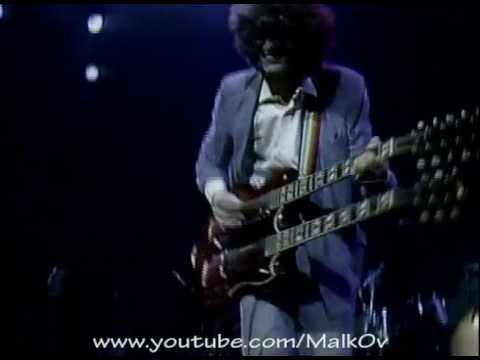
![The Yardbirds — live on French TV [Colourised] 1966 (feat. Jimmy Page & Jeff Beck)](https://i.ytimg.com/vi/ch03X7YHNJQ/hqdefault.jpg)

Watch & Listen
Discography
| Year | Title | Producer | Studio | Label | Chart | Sales | Musicians | YouTube | Notes |
|---|---|---|---|---|---|---|---|---|---|
| 1963 | "Diamonds" — Jet Harris & Tony Meehan (session guitar) | — | — | Decca | — | — | Jet Harris (Bass), Tony Meehan (Drums) | Page's first major session credit; reached No. 1 in the UK. | |
| 1967 | Little Games (with the Yardbirds) | Mickie Most | — | Epic | — | — | Keith Relf (Vocals), Chris Dreja (Bass), Jim McCarty (Drums) | Only studio album with Page as the Yardbirds' sole lead guitarist. | |
| 1993 | Coverdale–Page | Jimmy Page, David Coverdale | — | Geffen | — | — | David Coverdale (Vocals) | Collaboration with former Deep Purple/Whitesnake singer David Coverdale. | |
| 1994 | No Quarter: Jimmy Page and Robert Plant Unledded | Jimmy Page, Robert Plant | — | Atlantic | — | — | Robert Plant (Vocals) | Live album from the MTV "Unledded" special, reworking Led Zeppelin material with Egyptian and Moroccan musicians. | |
| 1998 | Walking into Clarksdale | Steve Albini | — | Mercury | — | — | Robert Plant (Vocals) | Studio album of new material with Robert Plant, produced by Steve Albini; won a Grammy. | |
| 2020 | Jimmy Page: The Anthology | — | — | Genesis Publications | — | — | — | Career-spanning archive book, later reissued in a more accessible edition, drawing on Page's personal collection of instruments, stage outfits, diaries and unpublished photographs. |
Famous songs
External links
Booking / Contact
Are you the artist, or do you represent the band or booking agency? We want the booking information here to always be accurate and current. Please send us the correct details via our contact form, and we'll update the profile as soon as possible. Go to the contact form